6234.
The Terrace. “Spring.”

The Terrace. “Spring.”
The Terrace. “Autumn.”
The Terrace “Winter.” Die at Foot of Steps.
The Terrace, Foliated Ramp. “Spring.” Flanking Steps.
The Terrace, Foliated Ramp. “Summer.” Flanking Steps.
The Park National Bank and Herald Building.
Facade of the Park National Bank.
The Broadway Bridge from St. Paul’s Churchyard.
St. Paul’s Church and Churchyard from the West.
Specimen of Bill Posting, Showing Grecian Bend.
Washington Monument, Union Square.
Washington Monument, Union Square.
Washington Monument, Union Square.
Steinway Hall.
Academy of Music.
National Academy of Design.
National Academy of Design.
Union League Club House, cor. 26th St. and Madison Avenue. The Union League was founded in 1863 to support the Union in the Civil War. This is the Union League Club’s second clubhouse, known as the Jerome Mansion, located at East 26th Street and Madison Avenue (across from Madison Square Park), built around 1865 for financier Leonard Jerome, father of Jennie Jerome (Lady Randolph Churchill). This opulent mansion, known for lavish parties, served as the club’s home from about 1868 until the club moved to its current Park Avenue location, with the mansion later demolished. The League is still operating as a private club in NYC.
The Jewish Synagogue, Fifth Avenue and 43d St.
The Jewish Synagogue, Fifth Avenue and 43d St.
26th Street, looking West from Madison Avenue.
Music Hall of the Central Park Garden. On the corner is the Central Park Hotel. The Central Park Hotel was listed in an 1859 NYC directory. The owner of the hotel was Hermann Knubel. The City of New York had acquired some of Hermann Knubel’s land for Central Park. So Mr. Knubel had apparent advance knowledge and quickly put that knowledge to work. Central Park was directly across from his hotel and the Broadway and Seventh Avenue train terminus was nearby. The Central Park Garden at 900 Seventh Avenue was opened next door to the hotel in May, 1868.
New York Stock Exchange, Broad Street.
New York Stock Exchange, Broad Street.
U.S. Custom House, Wall St.
The Herald Building and Park National Bank.
Herald Building and Park National Bank.
Broadway, head of Pine Street.
City Hall.
City Hall.
City Hall.
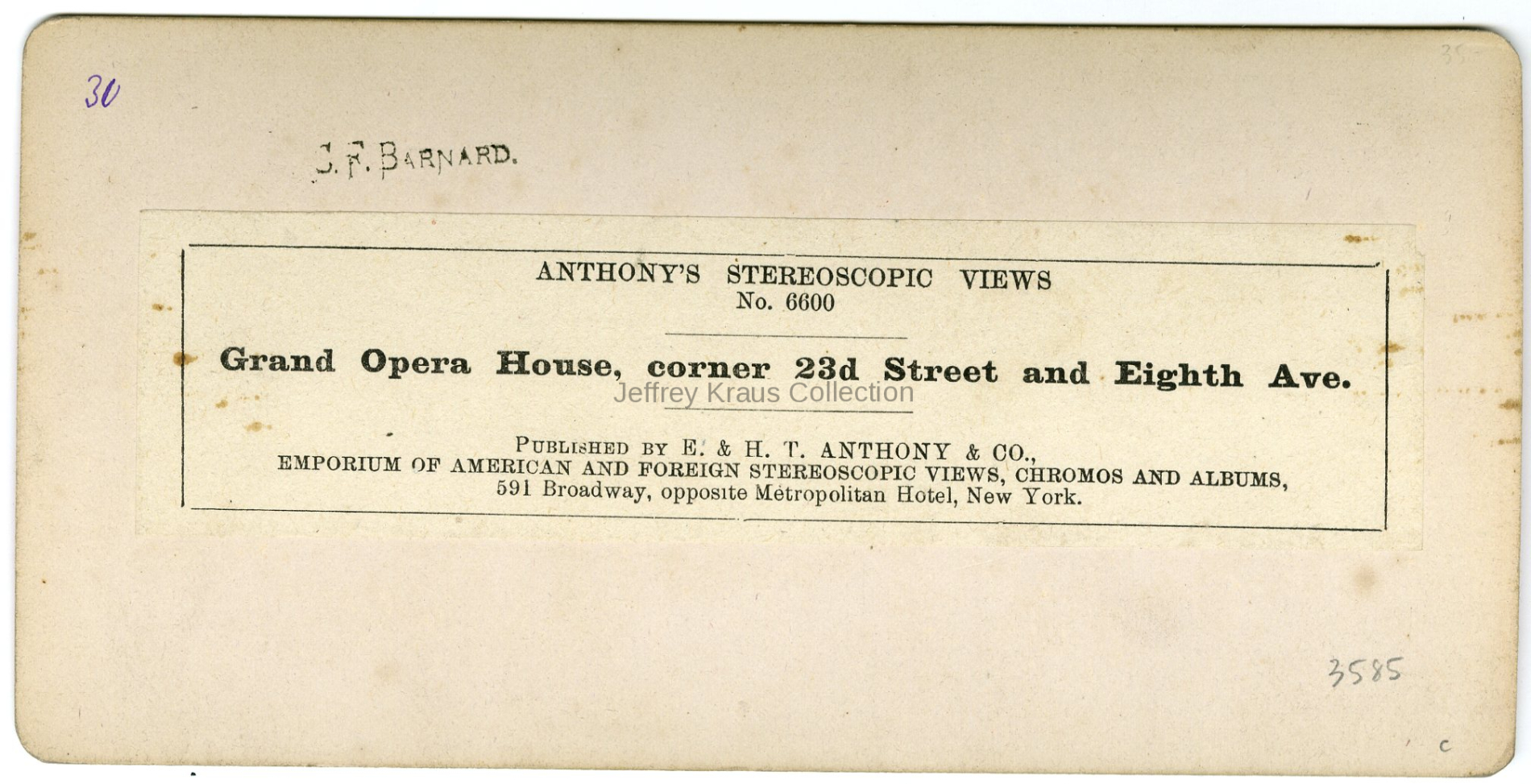
Grand Opera House, corner 23d Street and Eighth Ave. This building started life as Pike’s Opera House and was later renamed the Grand Opera House. It was a theater in NYC on the northwest corner of 8th Avenue and 23rd Street, in the Chelsea neighborhood of Manhattan. It was constructed in 1868, at a cost of a million dollars (equivalent to about 24.2 million in 2025), for distiller and entrepreneur Samuel N. Pike (1822–1872) of Cincinnati. The building survived in altered form until 1960 as an RKO movie theater, after which it was replaced by part of Penn South, an urban renewal housing development, and the SVA Theatre. Pike’s Opera House was built on what had been the property of Clement Clarke Moore, whose home, “Chelsea”, has given its name to the neighborhood. The architect was Griffith Thomas. The grand auditorium was seventy feet from parquet to dome, with sixproscenium boxes and two tiers. It could accommodate 1800 people, but over 3500 were known to have gained admittance at some popular performances. The first performance, on January 9, 1868, was Il trovatore, after which seven operettas by Jacques Offenbach were given in the space of four months. But the theater lost money initially, owing in part to competition from the Academy of Music on 14th Street.
Jim Fisk and Jay Gould bought Pike’s theater in January 1869 and renamed it the Grand Opera House. Fisk extended the repertory to include more operetta—Offenbach’s La Perichole had already received its American premiere there, January 4, 1869—and plays, like Victorien Sardou’s La Patrie, expressly translated for the theater. Vehicles for his mistress Josie Mansfield are often reported, though her name does not appear in the detailed cast lists in Brown. It was also reported, that her house west of the theater on 23rd Street was connected to the theater by a tunnel.
At the time when Fisk and Gould’s failed attempt to corner the market in gold resulted in “Black Friday,” Sept. 1869, Fisk barricaded himself in his second-floor premises at the opera house, which served as headquarters for his Erie Railway. When he was shot by his partner, Edward S. Stokes, Fisk’s body lay in state in the grand lobby.
In 1876, when the authorities began cracking down on theatre fire safety, the Grand Opera House was the only theatre to pass inspection. A rapid series of managers were unable to make the house a financial success, its overhead swallowing profit. “The house was considered, in theatrical parlance, a ‘Jonah’, and it was almost impossible to find any respectable manager who would take it,” according to theater critic Thomas Allston Brown. John F. Poole (1833–1893) and Thomas Lester Donnelly (1832–1880) rented the theatre in the Autumn of 1876, with the proviso that “a small percentage of the profits should go to the Erie Railway company.” The new management lowered the price of admission and catered to the popular tastes of New York’s “west side.” Uncle Tom’s Cabin (in blackface) and Buffalo Bill were among the first season’s attractions; theatrical productions were accompanied by “specialty acts.” When Donnelly died in 1880, Poole, in partnership with Donnelly’s widow, Sarah Donnelly (née Sarah D. Williams; 1840–1888), continued managing the theatre until May 31, 1882.
Looking down Wall Street from Trinity Spire.
Looking down Wall Street from Trinity Spire.
Looking across the North River from Trinity Spire.
Looking up Broadway, from Trinity Spire.
Bird’s Eye View of New-York City, from the Shot Tower.
Brooklyn Ferry Boat.
Brooklyn Ferry Boat.
Brooklyn Ferry Boat.
Laying the Pavement on Broadway below Wall St.
The Bulls and Bears of the Open Board.
Ferry Boat on Hudson River.
Ferry Boat on Hudson River.
Ferry Boat on Hudson River.
New York from Brooklyn Heights.
Foot of Montague St., Brooklyn, Governor’s Island in distance.
Wall St. Ferry, Brooklyn, New York in Distance.
Trinity Church, Brooklyn.
Mercantile Library, Brooklyn.