30712.
Commodore Foote’s Dream.

Commodore Foote’s Dream.
Master Tony Lowande, Liliputian Wonder.
Gen. Cardenas.
General Gardenas.
Dudley Foster, Age 4 years. Weight 5 pounds.
“Compliments of Miss Jennie Quigley, Scottish Queen,” written on verso.
Nellie Keeler, as Little Queen Mab. 12 years of age, 28 inches high, weight 12 lbs.
Nellie Keeler (April 6, 1875 – 1903) was an American child circus performer known as Little Queen Mab. Nellie Keeler was born with dwarfism on April 6, 1875, in Kokomo, Indiana. She was the youngest of three daughters and a son raised by Ezra and Maria Keeler. Her father was a farmer and a Civil War veteran, having served with the 4th Indiana Cavalry. Ezra Keeler died in 1917 while in his seventies at a home for disabled war veterans in Marion, Indiana. Maria Keeler lived to be in her late eighties, and died in 1937 in Kokomo. By the age of three Nellie Keeler came to the attention of P. T. Barnum through local press articles about her diminutive stature. Nellie weighed only eleven pounds and stood just a few inches over two feet. After a successful four-week tryout in 1878 she began touring with Barnum’s circus, along with the company of her father, as the “sweet girl with radiant golden hair.” Barnum placed her on a stage a few feet above the floor in a fashionable blue cashmere costume and short skirt. Next to her sat Colonel Routh Goshen, a man Barnum claimed stood nearly eight foot tall and weighed over six hundred pounds. Nellie’s contract with Barnum stipulated bad childhood behavior could void her contract and deprive her family of a potential income of a hundred dollars a month. Nellie’s employment with Barnum came to an end when by the age of twelve she was no longer a tiny little girl. Over her short six-year career Nellie was billed as “a microscopic bud of humanity,” “a little elf,” “a fairy beauty,” a “pocket volume of humanity” and “the Indiana Midget.” Nellie’s circus income enabled her father to become an independent farmer, free of mortgage. Her obituary, which appeared in the June 18, 1903, issue of the New York Times, stated she died at age twenty-eight from tuberculosis at her residence near Versailles, Indiana, and that she had been in declining health since her teens.
Admiral Dot. Thirteen years old; Twenty-five inches high; Weighs only fifteen pounds.
Admiral Dot. Age 23.
Gen. Chas. Decker. 23 Years Old-Height 31 inches-Weight 45 lbs.
George L. Fox, clown. [D]
George L. Fox, clown.
P.T. Barnum.
Chang and Eng and two of their children.
P.T. Barnum.
Circassian woman.
5 guys playing dress-up, maybe clowns.
Hanson, Ventriloquist.
Santa Claus.
Madam Minnie Shaw and Child.
Microcephalic siblings.
E.W. Worth’s American Museum. Baby Mummy over 3000 years old.
Compliments of Zalumma Agra, The Star of the East.
Zalumma Agra, The Star of the East.
Zalumma Agra, The Star of the East.
Unidentified Circassian.
Unidentified Circassian.
Unidentified Circassian and daughter.
Aggie Zolutia, Madagascar Lady.
Zuruby Hannum, Circassian Beauty.
Madame Milo, woman with long hair.
Barnum’s hairy man.
Chang-Yu-Sing, Chinese Giant.
Col. Noah Orr, The American Giant. Height 8 ft, 8 in., weight 550 lbs., age 22 years, at Barnum’s Museum.
The Original Eliophobus Family. Rudolph Lucasie, Wife and Son. From the Island of Madagascar. Prominent Peculiarities. White Silken Hair. Alabaster Complexion. Eyes Pink. Pupils Angular, nearly square.
Albino Woman with Parrot.
Chang and Eng, Siamese Twins.
John S. Elliott, largest man in Maryland. Signed on verso. The following from his death notice: “Death of the Largest Man in Maryland. John S. Elliott died at his residence in Queen Anne’s county, Md., on Sunday, of pneumonia, aged fifty-nine years. He was the largest man ever raised in Maryland, and perhaps in the United States. A few years ago, while exhibiting, he weighed nearly five hundred pounds; of late he had fallen off, and his weight was reduced to less than four hundred pounds. In height he was five feet ten inches, and two feet across from shoulder to shoulder. He generally enjoyed good health, but the disease from which he died carried him off after a few days’ illness. He was a native of Queen Anne’s county, but was well known in the adjacent counties.”
Circassian Woman.
Young Acrobats.
Dan Rice, celebrated circus clown.
Ball walker.
Che-Mah, the Chinese Dwarf.
Maximo & Bartola, Aztecs of Ancient Mexico. Máximo and Bartola (also known as Maximo Valdez Nunez and Bartola Velasquez respectively) were the stage names of two Salvadoran siblings both suffering from microcephaly and cognitive developmental disability who were exhibited in human zoos in the 19th century. Originally from near Usulután, El Salvador, the siblings were given by their mother to a merchant who promised he would take them to Grenada to be educated and exhibited. They then went through several guardians afterwards. They were eventually billed as “Aztec Children” and an elaborate story was constructed of how they were found in the temple of a lost Mesoamerican city. They toured the U.S. and Europe, appearing before various regents and dignitaries.
Unidentified Circassian Snake Lady.
Col. Routh Goshen, the “Arabian Giant,” 8 feet high-weight 475 lbs.
Col. Routh Goshen, the “Arabian Giant,” 8 feet high-weight 475 lbs.
Albino woman.
Col. Routh Goshen, The Arabian Giant. 8 feet high–weight 475 lbs. As exhibited at Barnum’s Museum, New York.
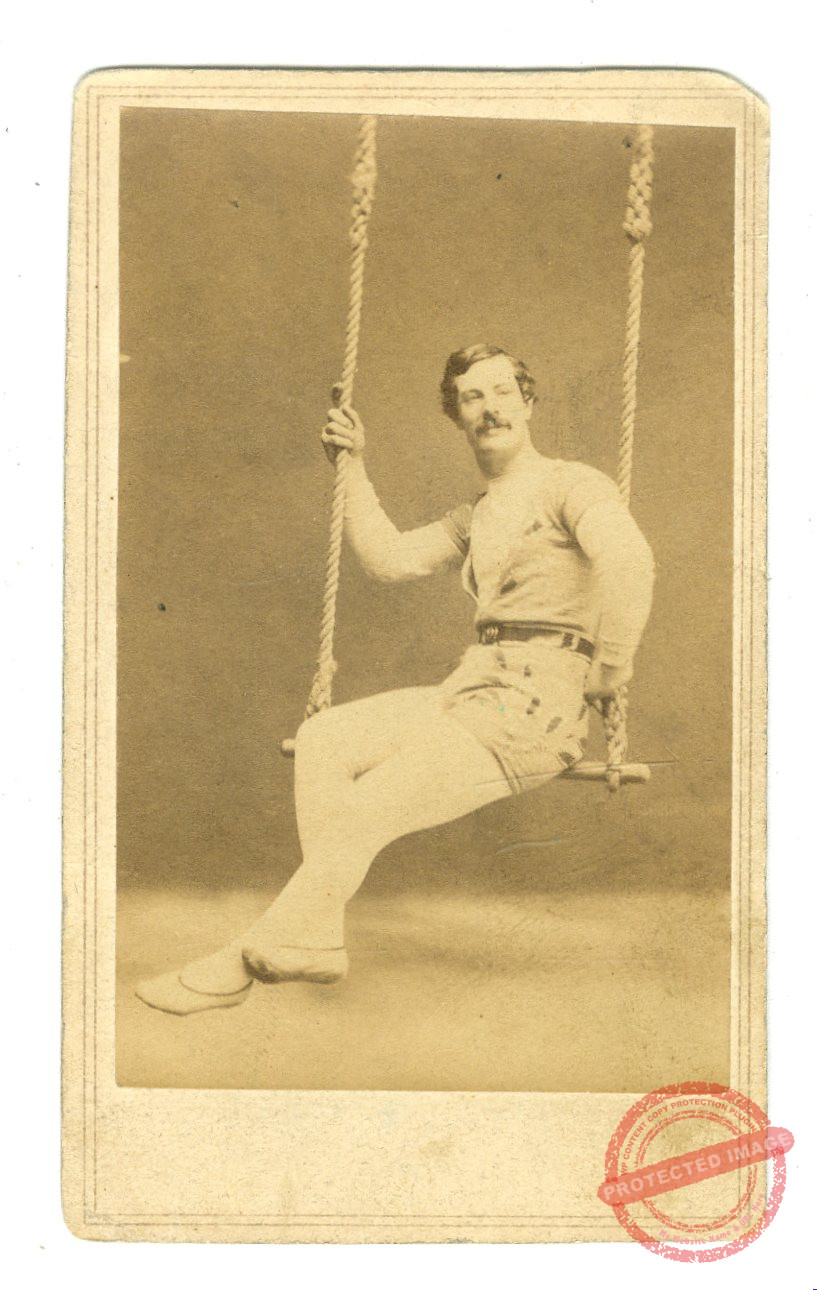
Léopold Verrecke was a renowned 19th-century Belgian trapeze artist and gymnast who later became a wartime balloon pilot during the Siege of Paris. Billed in performances as “Verrecke the Great Gymnast,” he gained widespread fame in the 1860s as a premier aerialist alongside pioneers like Jules Léotard. Verrecke achieved star status when engaged by director Louis Dejean to perform at the famous Cirque Napoleon (now the Cirque d’Hiver) in Paris during the 1860s. At the time, the word “gymnast” was commonly used to describe circus aerialists and acrobats. Verrecke was celebrated for his daring feats on the flying trapeze, a discipline invented by Jules Leotard at that very venue in 1859.
Like other major acrobats of the era, he toured internationally and posed for cartes de visite showcasing his athletic physique and circus costumes. During the Franco-Prussian War (1870–1871), when Prussian forces surrounded Paris, the French government recruited daring circus acrobats, sailors, and athletes to pilot hot-air and gas balloons carrying mail and dispatches out of the besieged city. On December 20, 1870, Verrecke piloted the mail balloon Général Chanzy, departing from the Gare du Nord in Paris at 2:00 a.m. with three passengers, carrier pigeons and 25 kilograms of mail including a letter from Georges Clemenceau to his wife. Strong winds blew the balloon off course into enemy territory, landing in Roedersdorf, Bavaria, at 10:20 a.m.. Prussian forces captured Verrecke, his passengers, and the mailbags. Because Prussian Chancellor Otto von Bismarck had previously threatened to treat captured balloonists as spies rather than regular soldiers, widespread rumors circulated in France that Verrecke and his crew had been executed by firing squad. Verrecke and the passengers were subjected to mistreatment and a grueling captivity in Bavaria, though they all survived the war and were not executed.