40176.
398. Camp Life, Upper Ausable Pond, Sept. 8, 1876. Seneca Ray Stoddard self portrait sitting at the table facing camera. The string to pull the shutter is visible.

398. Camp Life, Upper Ausable Pond, Sept. 8, 1876. Seneca Ray Stoddard self portrait sitting at the table facing camera. The string to pull the shutter is visible.
Self-portrait of Colonel Speck with huge camera from the studio of McFarlin & Speck’s Studio, Elmira, NY.
20-The Basaar, Taughannock. Small sign reads “G.F. Gates, Glen Views on Sale Here.”
Rock City, (near Olean). There is a photographer working under the dark tent at right, his hat lays on the ground.
49. A dangerous position-H.C. White Co. Photographer working on column of new building, 250 feet above ground, New York.
8288. Looking N. up Fifth Ave. past Flatiron Bldg. and Madison Sq., New York. The man on the girder is identified as Horace Dade Ashton. In The Spirit of Villarosa: A Father’s Extraordinary Adventures; A Son’s Challenge by Horace Ashton and Marc Ashton, a biography of Horace Dade Ashton by his sons, it is stated that “My favorite Horace Ashton photograph hangs on the wall in my home. It is the famous black-and-white self-portrait he took from the top of the Woolworth Building in Manhattan. In the picture I have, he is sitting on the girder high above the city. The photograph is my favorite for a number of reasons, certainly because it is a wonderful example of classic American art of the twentieth century, but mostly because it is so typical of Dad. I’m sure he enjoyed the thrill of it all that day.” In this quote the image is referred to as a “self-portrait” which would mean Horace Dade Ashton is both the subject and the photographer.
8295. Banquet given by H.C. White Co., to salesmen from Colgate University, May 23, 1904, at Windsor Hotel, Hamilton, NY.
Alexander R. Beckers. Beckers first saw a daguerreotype in Philadelphia, and subsequently went to work there for photographer Frederick David Langenheim in 1843. The following year he moved to New York, where he is credited with the first whole-plate daguerreotypes made in that city. Within months Beckers opened the Langenheim & Beckers studio in New York, which became Beckers & Piard in 1849. In 1857 he patented a revolving stereograph viewer and shortly thereafter sold his daguerreotype business in order to concentrate his attention on the manufacture of stereograph viewers.
Self-portrait of George Rockwood (4/12/32-7/10/11), NYC photographer. It looks like Mary Rockwood was practicing her penmanship on verso.
Exterior of Louis Alman’s photo studio, Lake Mahopac, NY.
Exterior of Slee Bros. Photography Gallery, Poughkeepsie, NY. The brothers are probably the men on the balcony.
Vail Brothers, “The” Photographers, 254 and 256 Main Street, Poughkeepsie, New York.
G.W. Pach, Photographer, No. 9 Garden Street, Near Main St., Poughkeepsie, NY.
E.M. Collins, Photographer and Frame Maker, 182 West First Street, Oswego, NY.
Photo display outside the studio of Thomas & Treadwell, Gouverneur, NY.
A.E. Alden’s Picture Rooms.
Photographer with his Lewis chambered edge bellows daguerreian camera.
Biffar Photographer Studio, Williamsburgh, Brooklyn, NY.
703. A Bolton Frost (24 inches in 10 hours). S.R. Stoddard’s photographic sleigh wagon.
Samuel F.B. Morse.
The 5 Slee Brothers.
On the Road Bangall to Po’keepsie, June 17th, 1863. Two of the Slee Brothers.
Grays Block, Marathon, NY. Photo Gallery.
Monument Square, Front St., Ballston Spa, NY. Image shows the studio of J.S. Wooley and a banner for Wooley hanging across the street.
Enlargement of part of above view.
E.M. Johnson’s Tent.
Composite card of 9 images of the photographer Singhi.
Camera Obscura, Glen Island, N.Y.
Little Ina. I believe that this is A.C. McIntyre, the photographer, and his daughter.
J.J. Reilly’s Photographic Pavilion at the Falls. A camera can be seen within. The sign reads “Photographic & Stereographic Views of the Falls.”
No. 485. The Photographers. George Stacy stands second from right by the camera. Others have viewers, etc.
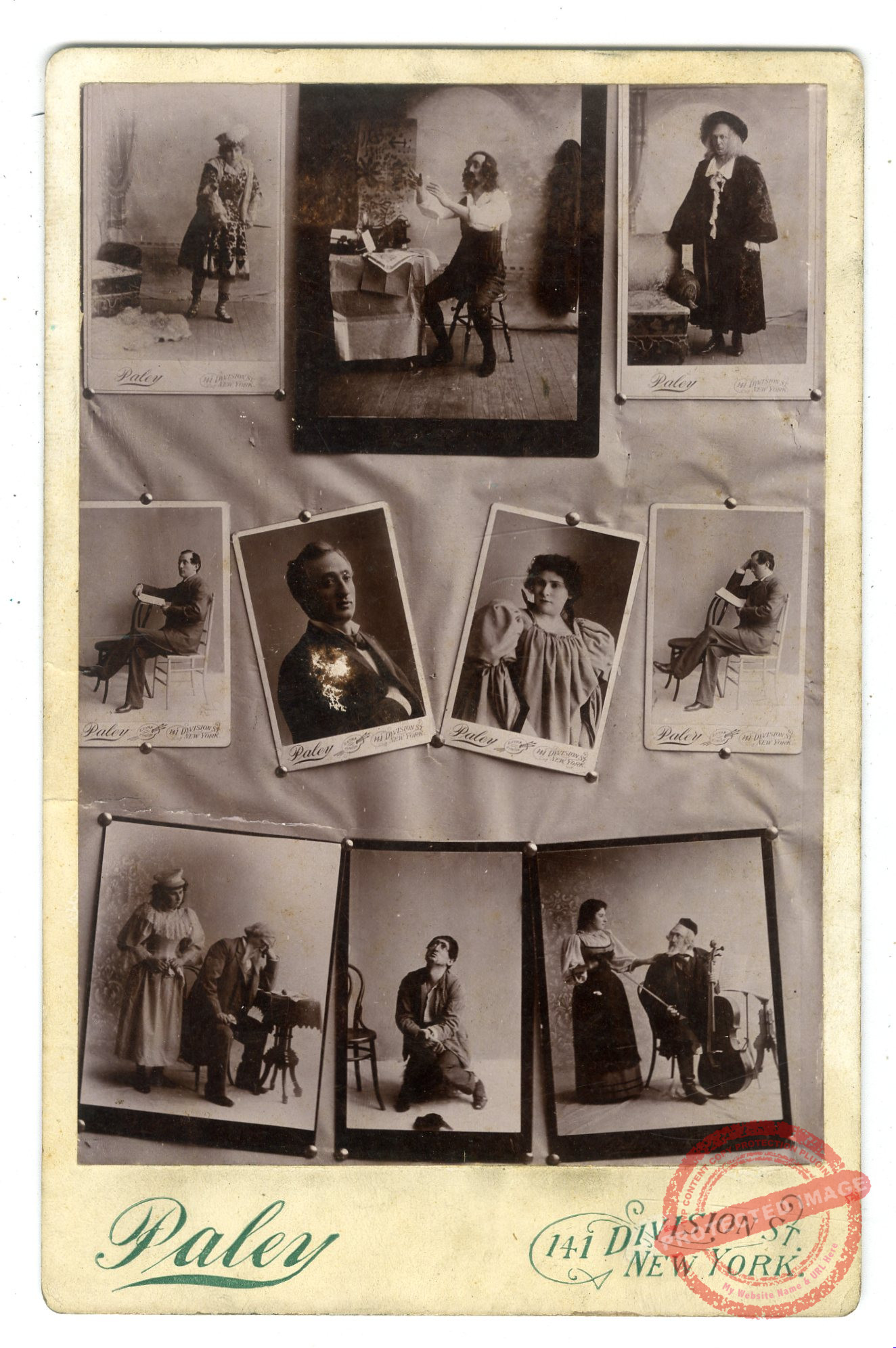
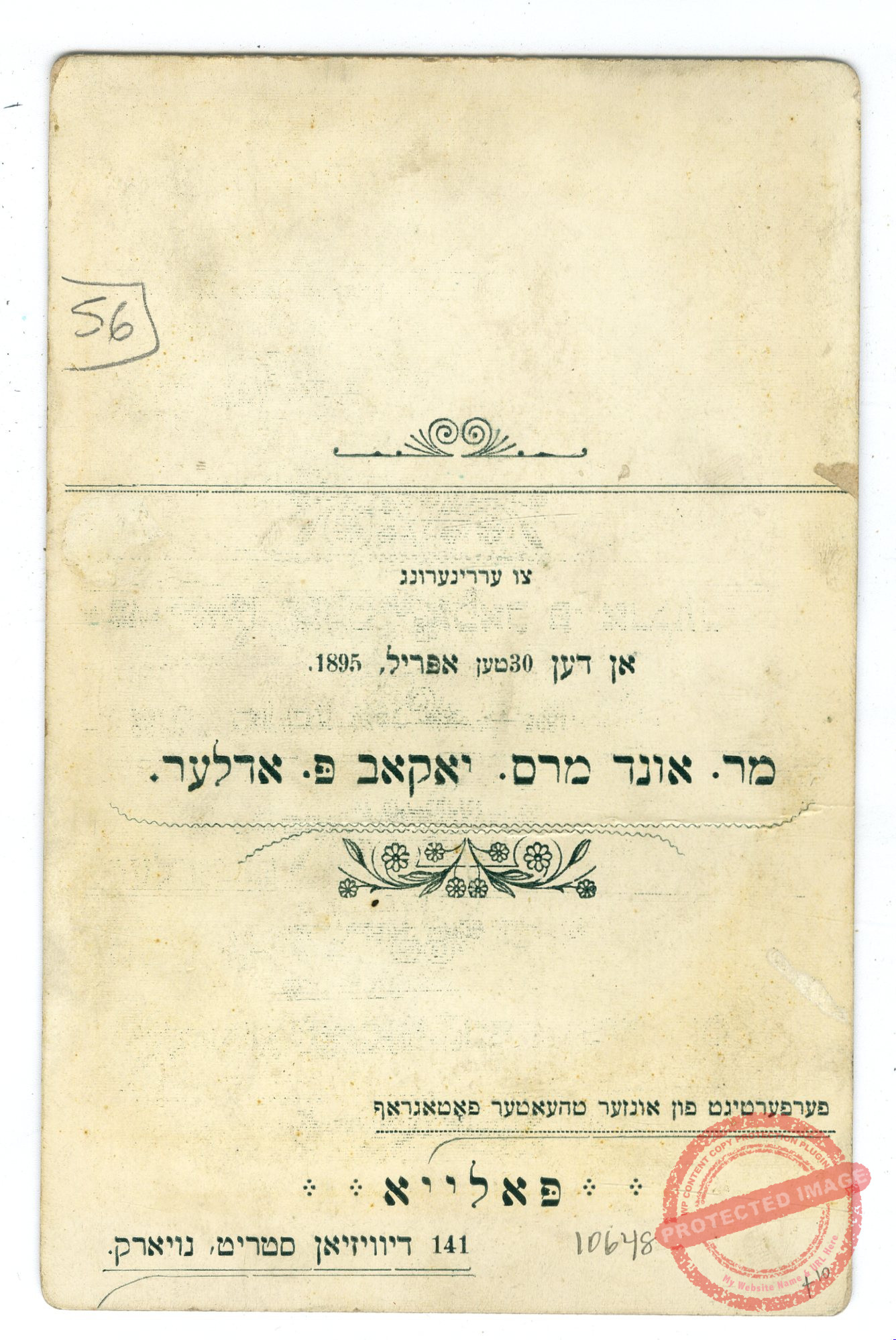
Sample card for Paley, a lower-east side photographer. Hebrew on verso. These are photos of the famous Yiddish actor, Jacob P. Adler, and his wife Sarah, taken in 1895. (They married four years earlier). At the time they ran a theatre, the Adler Theatre, on the Lower East Side. Earlier that month, on April 6, both starred in a play in honor of Passover: “Der shvartser yid, oder, Meier Yozefovitsh”. The stage director was Max Rosenthal (also an actor). The Yiddish play Der shvartser yid, oder, Meier Yozefovitsh (The Black Jew, or Meier Josephovich) was written by Jacob Gordin in 1895.
Niagara Falls Scenery. McPherson’s Gallery is at right.
Grove Scenery-Winter. The “Photographic Views” pavilion is seen at right.
Formation at West Point. The photographer’s shadow can be seen at bottom right.
No. 391. The Tunnel under Break-Neck.
E. Lewis’ Photograph Gallery, Kingston.
Po’Keepsie NY looking West. The Slee Brothers gallery can be seen at lower center with the skylight.
Getting Ice at the Gregory House, Lake Mahopac. Folsom’s studio is at center with image displays.