4572.
Group of Soldiers charging with Bayonets, on board of the Italian man of war Re Galantuomo, in N.Y. Harbor, 1862. (This is the incorrect date as the ship did not arrive in NY Harbor until Nov. 1863.) Partial 2-cent tax stamp on verso.

Group of Soldiers charging with Bayonets, on board of the Italian man of war Re Galantuomo, in N.Y. Harbor, 1862. (This is the incorrect date as the ship did not arrive in NY Harbor until Nov. 1863.) Partial 2-cent tax stamp on verso.
Group of Boys, on board the Italian man of war Re Galantuomo, in N.Y. Harbor, 1862. (This is the incorrect date as the ship did not arrive in NY Harbor until Nov. 1863.)
Group of Soldiers at rest, on board the Italian man of war Re Galantuomo, in N.Y. Harbor, 1862. (This is the incorrect date as the ship did not arrive in NY Harbor until Nov. 1863.)
Group of Equipage of the Italian man of war, Re Galantuomo, in N.Y. Harbor, 1862. (This is the incorrect date as the ship did not arrive in NY Harbor until Nov. 1863.)
Group of Officers, on board the Italian man of war Re Galantuomo, in N.Y. Harbor, 1862, the Commandant Comte Ulisse Isola. (This is the incorrect date as the ship did not arrive in NY Harbor until Nov. 1863.)
Sotto tenente Di Gascello, Sig. Sattembini on board of the Italian Man of War, Re Galantuomo, N.Y. Harbor, 1862. (This is the incorrect date as the ship did not arrive in NY Harbor until Nov. 1863.)
Wall St. Ferry, N.Y.
Foot of King St. Pier No. 46, N.R. New York City.
Foot of King St., New York. Steamboat Morning Star.
Foot of King St., New York. Steamboat Morning Star.
Steamboat for Albany, Pier No. 16 N.R. New York City. 2-cent tax stamp on verso.
Foot of Courtlandt St. N.R. New York City.
Foot of Courtland St., N.R. New York City.
Castle Garden, New York. Stereoview titled Castle Garden. This building is historically known as West Battery or Fort Clinton, and today is preserved as Castle Clinton National Monument. It is a historic circular sandstone fort located in Battery Park at the southern tip of Lower Manhattan. Over its more than two-century history, the landmark underwent several distinct evolutionary phases 1. Military Fort (1808–1811). Built as an artificial island fort off the Manhattan shore to defend New York Harbor during the War of 1812. Designed by architect John McComb Jr. and engineer Jonathan Williams. It was garrisoned, though it never actually fired a shot in combat. 2. Entertainment Center & Beer Garden (1824–1855). Leased to New York City and renamed Castle Garden, the venue was converted into a sprawling open-air concert hall, theater, and restaurant space. It hosted massive cultural events, including a celebrated 1850 concert by Swedish opera singer Jenny Lind. Landfilling eventually connected the offshore fort directly to the mainland of Manhattan. 3. America’s First Immigration Depot (1855–1890). Opened on August 3, 1855, as the nation’s first official, centralized immigration processing station—predating Ellis Island by decades. Over the next 35 years, more than 8 million immigrants (roughly 75% of all U.S. arrivals at the time, primarily from Ireland, Germany, and later Southern and Eastern Europe) passed through its doors before it closed on April 18, 1890. 4. New York City Aquarium (1896–1941). Altered and reopened on December 10, 1896, serving as one of New York City’s most popular public attractions for decades. 5. National Monument & Today (1946–Present). Saved from a proposed demolition by Robert Moses in the 1940s, the structure was designated a national monument and restored. Today, managed by the National Park Service in partnership with The Battery Conservancy, it serves as a small history museum, a ranger-guided tour site, and the primary ticketing and security gateway for the Statue of Liberty and Ellis Island ferries. Admission to the monument and its exhibition room is free.
Lafayette Place, from Great Jones St. New York.
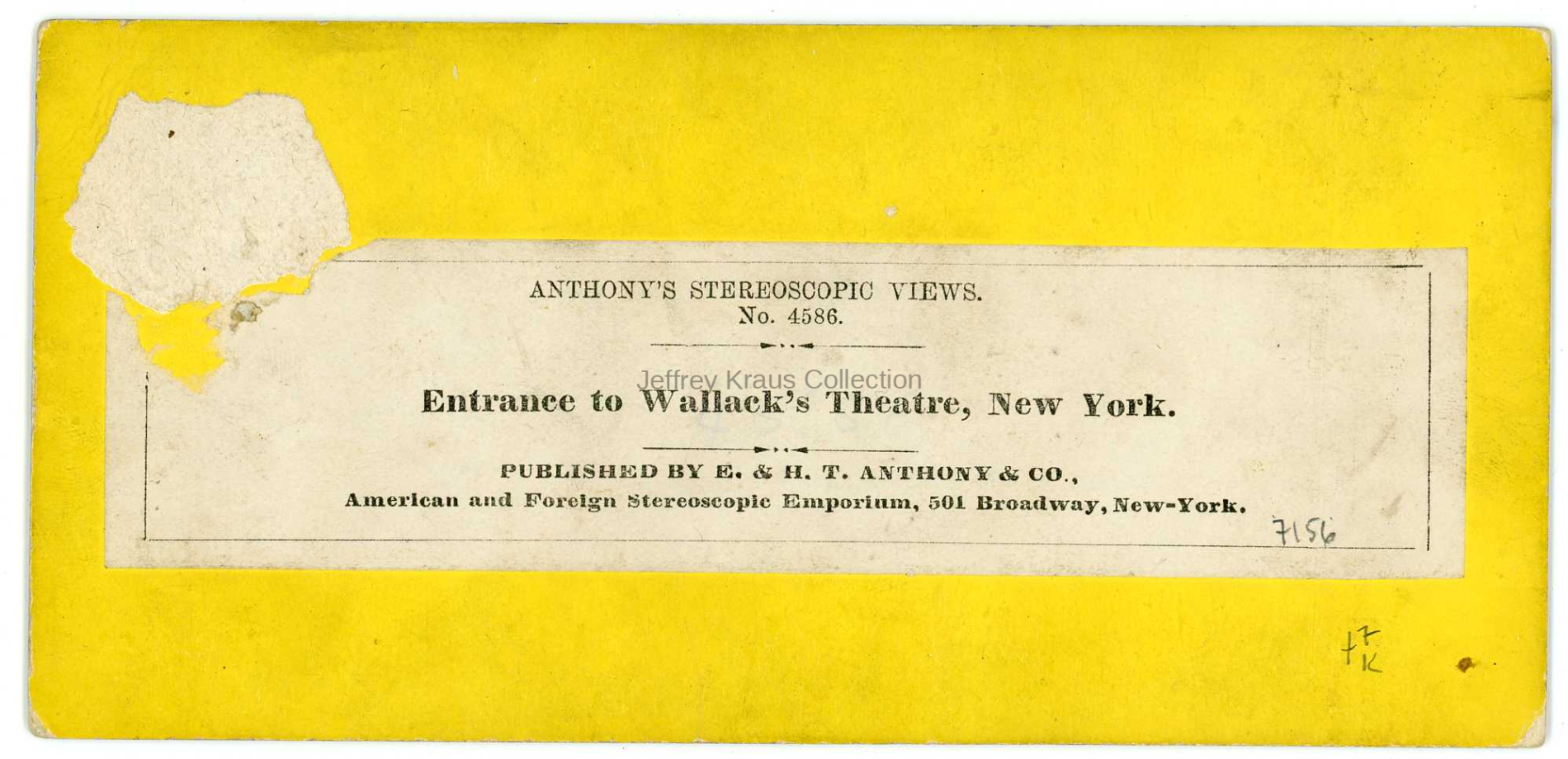
Entrance to Wallack’s Theater.
Hope. Marble Yard of Mess. Casone & Isola, N.Y. City.
High Bridge.
High Bridge.
Landscape and Sky, High Bridge.
Funeral of President Lincoln, N.Y. City. 23d Regiment passing in view.
Funeral of President Lincoln, N.Y. City. Regiment of Artillery passing in view.
Funeral of President Lincoln, N.Y. City. 7th Regiment passing in view. This is the image which supposedly shows 6 1/2 year old Theodore Roosevelt in the window at left.
Funeral of President Lincoln, N.Y. City. 27th Regiment passing in view.
Ruins of St. George’s Church, Rutherford Place, N.Y. Rector, Stephen H. Tyng. Front View from the S.E. corner of Stuyvesant Square.
Ruins of St. George’s Church, Rutherford Place, N.Y. Rector, Stephen H. Tyng. Front View from the S.E. corner of Stuyvesant Square.
Ruins of St. George’s Church, Rutherford Place, N.Y. Rector, Stephen H. Tyng. Exterior View of the South side from the East side of Rutherford Place.
Ruins of St. George’s Church, Rutherford Place, N.Y. Rector, Stephen H. Tyng. Interior View of the Chancel Apse from the South side.
Ruins of St. George’s Church, Rutherford Place, N.Y. Rector, Stephen H. Tyng. Interior View of the Chancel Apse from the S.W. corner of the Tower.
Ruins of St. George’s Church, Rutherford Place, N.Y. Rector, Stephen H. Tyng. Interior View of the South side, and the Chancel, from the S.W. cor. of North Tower.
Ruins of St. George’s Church, Rutherford Place, N.Y. Rector, Stephen H. Tyng. Interior Chancel.
Ruins of St. George’s Church, Rutherford Place, N.Y. Rector, Stephen H. Tyng. Interior view of the South side, from the North side of the Chancel.
Ruins of St. George’s Church, Rutherford Place, N.Y. Rector, Stephen H. Tyng. Interior view of the North side, from the South side of the Chancel.
Ruins of St. George’s Church, Rutherford Place, N.Y. Rector, Stephen H. Tyng. Exterior view of the South side from the East side of Rutherford Place.
Front View of the “Tombs,” Centre St.
Front View of the “Tombs,” Centre St.
New York Free College, East 23d. St. and Lexington Avenue.
7th Regt. Armory, 3d Avenue, New-York. Label on verso “Sold at Bogardus’ Art Gallery, 1153 Broadway, Near 27th St. New York.”
National Academy of Design, 23d St., N.Y.
Haughworth’s Iron Building, cor. Broadway and Broome St.
Hoffman House, cor. Broadway and 24th St.
Hoffman House, cor. Broadway and 24th St.
N.Y. State Arsenal, 7th Ave. and 35th St.
Calvary Church, 4th Ave. and 22d St.
Broadway Tabernacle, 34th St., and Broadway. Rev. Dr. Thompson.
Skating Scene in Central Park, Winter 1866.
Skating Scene in Central Park, Winter 1866.
Skating Scene in Central Park, Winter 1866.
Skating Scene in Central Park, Winter 1866.
Skating Scene in Central Park, Winter 1866.