30807.
Montreal. Man on stilts among children in a field.

Montreal. Man on stilts among children in a field.
Col. Routh Goshen, the “Arabian Giant,” 8 feet high-weight 475 lbs.
Col. Routh Goshen, the “Arabian Giant,” 8 feet high-weight 475 lbs.
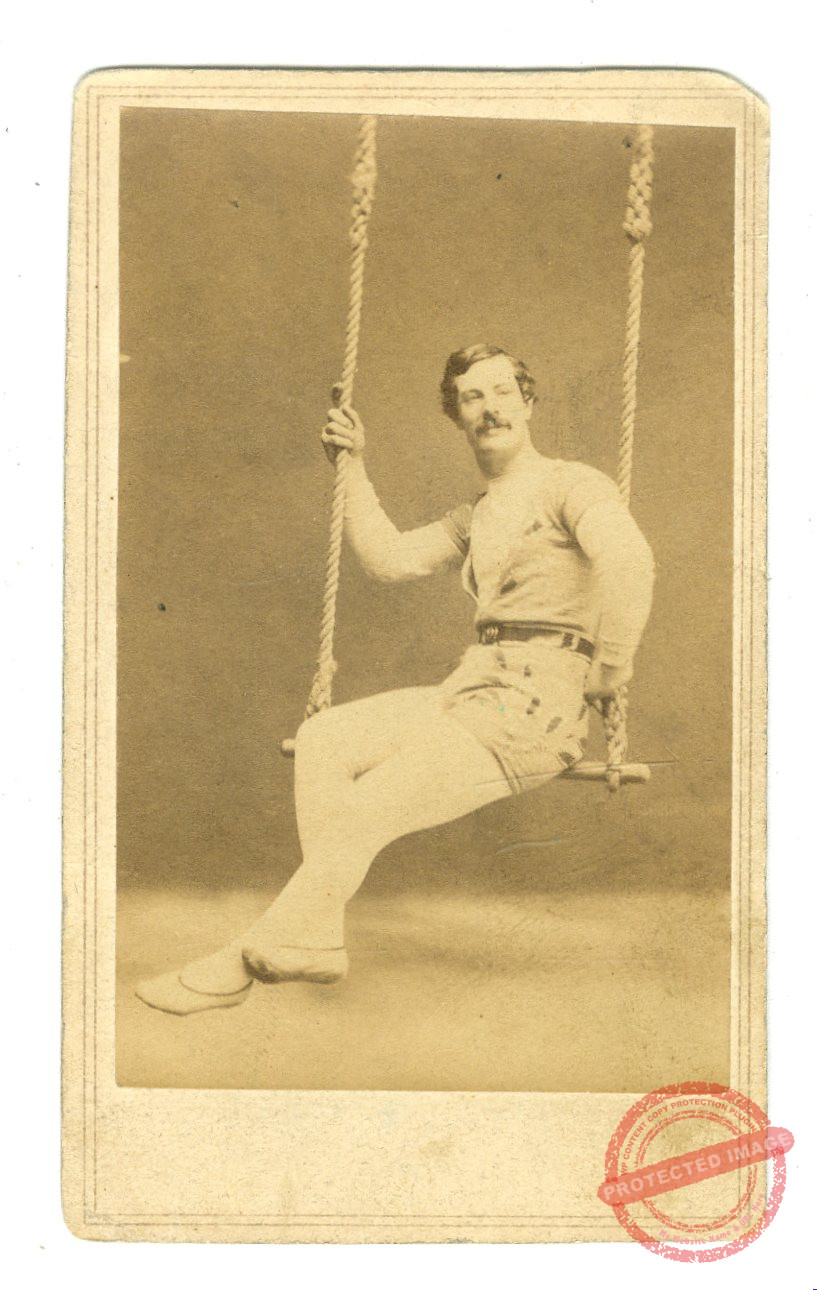
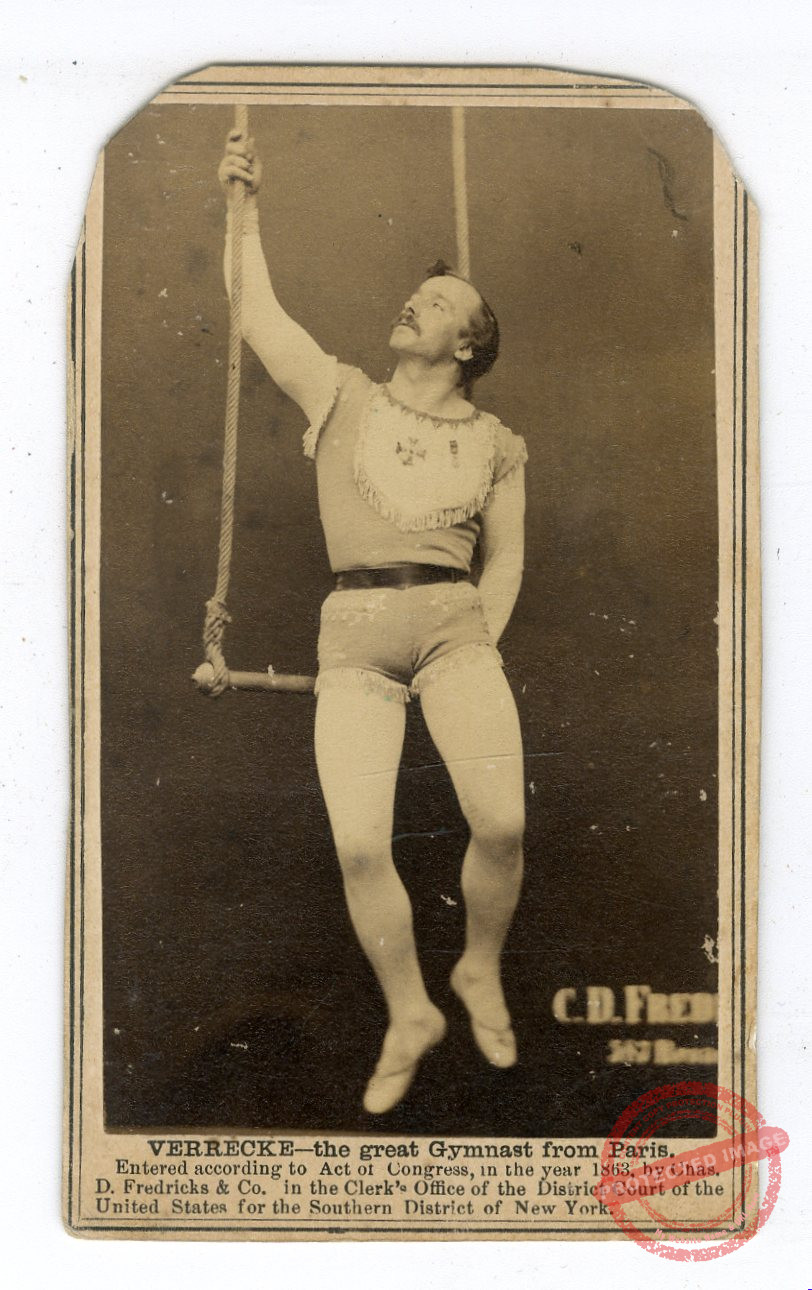
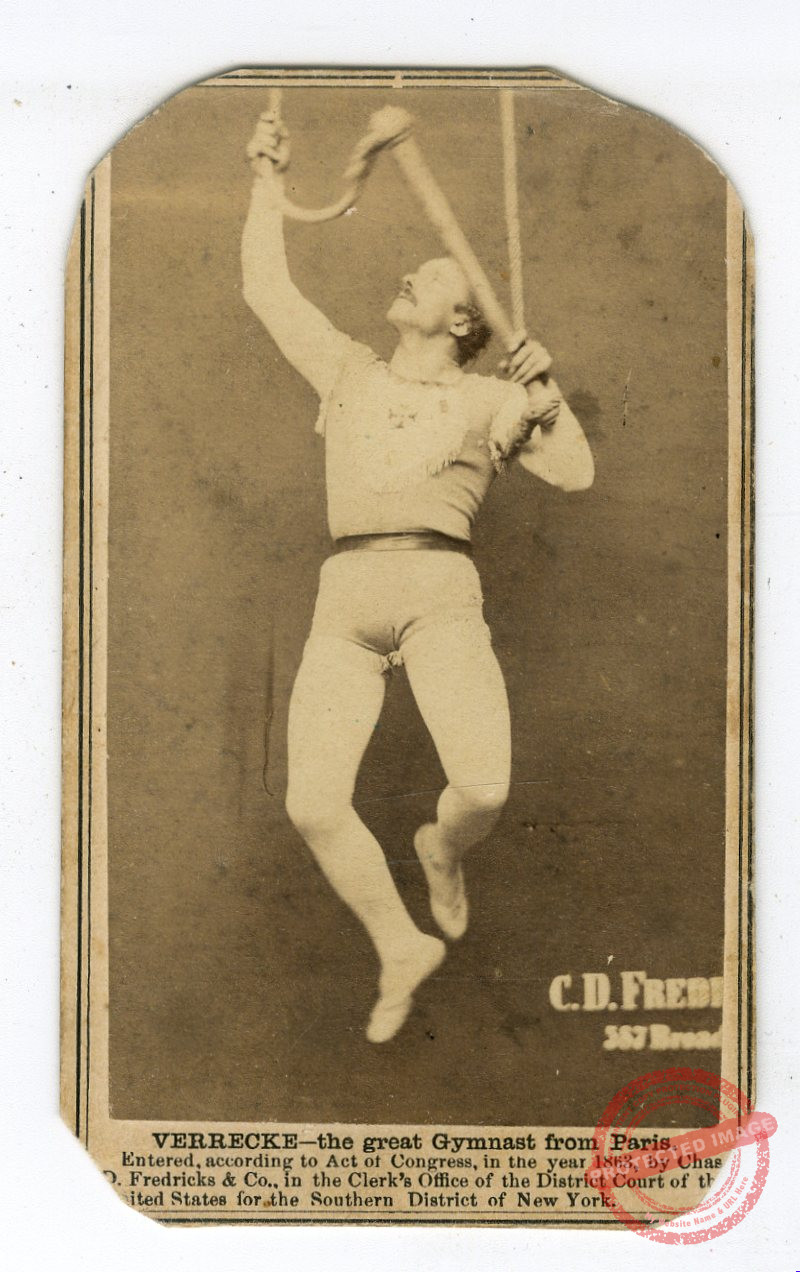
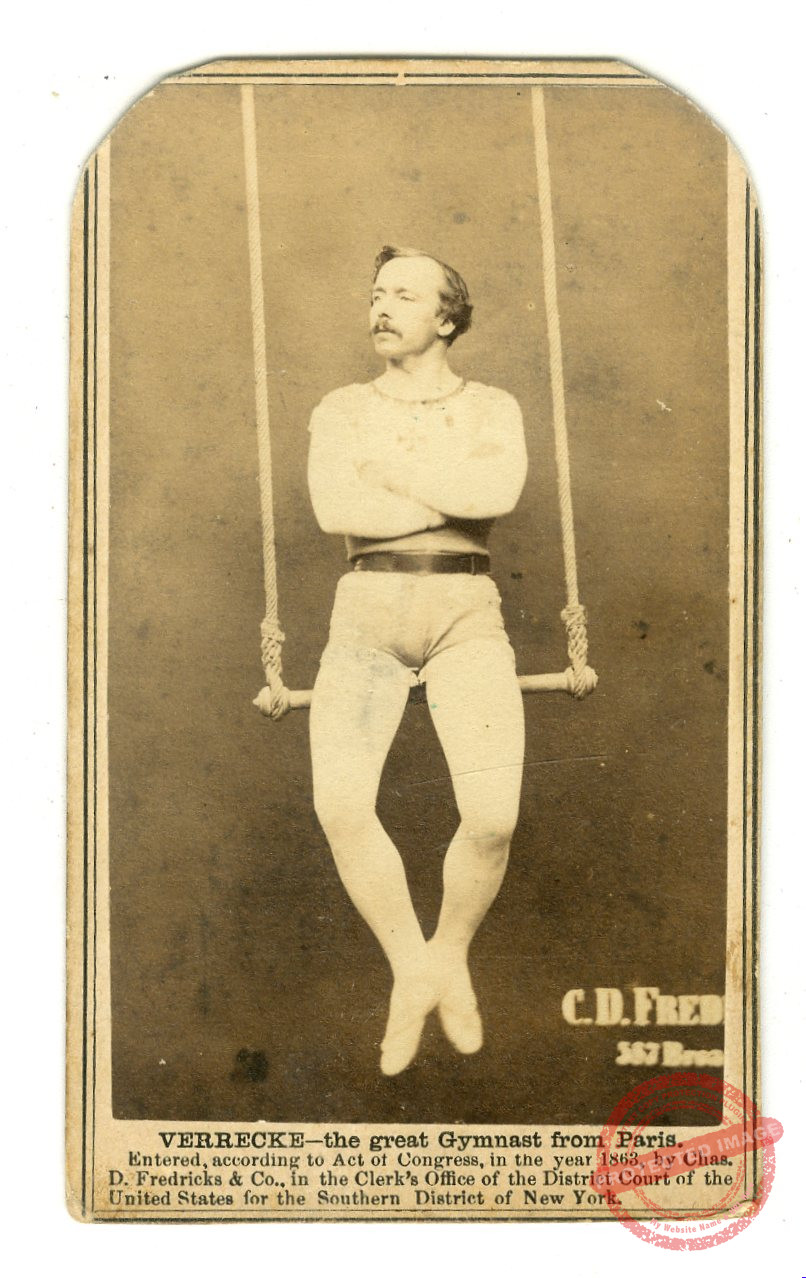
Léopold Verrecke was a renowned 19th-century Belgian trapeze artist and gymnast who later became a wartime balloon pilot during the Siege of Paris. Billed in performances as “Verrecke the Great Gymnast,” he gained widespread fame in the 1860s as a premier aerialist alongside pioneers like Jules Léotard. Verrecke achieved star status when engaged by director Louis Dejean to perform at the famous Cirque Napoleon (now the Cirque d’Hiver) in Paris during the 1860s. At the time, the word “gymnast” was commonly used to describe circus aerialists and acrobats. Verrecke was celebrated for his daring feats on the flying trapeze, a discipline invented by Jules Leotard at that very venue in 1859.
Like other major acrobats of the era, he toured internationally and posed for cartes de visite showcasing his athletic physique and circus costumes. During the Franco-Prussian War (1870–1871), when Prussian forces surrounded Paris, the French government recruited daring circus acrobats, sailors, and athletes to pilot hot-air and gas balloons carrying mail and dispatches out of the besieged city. On December 20, 1870, Verrecke piloted the mail balloon Général Chanzy, departing from the Gare du Nord in Paris at 2:00 a.m. with three passengers, carrier pigeons and 25 kilograms of mail including a letter from Georges Clemenceau to his wife. Strong winds blew the balloon off course into enemy territory, landing in Roedersdorf, Bavaria, at 10:20 a.m.. Prussian forces captured Verrecke, his passengers, and the mailbags. Because Prussian Chancellor Otto von Bismarck had previously threatened to treat captured balloonists as spies rather than regular soldiers, widespread rumors circulated in France that Verrecke and his crew had been executed by firing squad. Verrecke and the passengers were subjected to mistreatment and a grueling captivity in Bavaria, though they all survived the war and were not executed.
Verrecke-the great Gymnast from Paris.
Léopold Verrecke was a renowned 19th-century Belgian trapeze artist and gymnast who later became a wartime balloon pilot during the Siege of Paris. Billed in performances as “Verrecke the Great Gymnast,” he gained widespread fame in the 1860s as a premier aerialist alongside pioneers like Jules Léotard. Verrecke achieved star status when engaged by director Louis Dejean to perform at the famous Cirque Napoleon (now the Cirque d’Hiver) in Paris during the 1860s. At the time, the word “gymnast” was commonly used to describe circus aerialists and acrobats. Verrecke was celebrated for his daring feats on the flying trapeze, a discipline invented by Jules Leotard at that very venue in 1859.
Like other major acrobats of the era, he toured internationally and posed for cartes de visite showcasing his athletic physique and circus costumes. During the Franco-Prussian War (1870–1871), when Prussian forces surrounded Paris, the French government recruited daring circus acrobats, sailors, and athletes to pilot hot-air and gas balloons carrying mail and dispatches out of the besieged city. On December 20, 1870, Verrecke piloted the mail balloon Général Chanzy, departing from the Gare du Nord in Paris at 2:00 a.m. with three passengers, carrier pigeons and 25 kilograms of mail including a letter from Georges Clemenceau to his wife. Strong winds blew the balloon off course into enemy territory, landing in Roedersdorf, Bavaria, at 10:20 a.m.. Prussian forces captured Verrecke, his passengers, and the mailbags. Because Prussian Chancellor Otto von Bismarck had previously threatened to treat captured balloonists as spies rather than regular soldiers, widespread rumors circulated in France that Verrecke and his crew had been executed by firing squad. Verrecke and the passengers were subjected to mistreatment and a grueling captivity in Bavaria, though they all survived the war and were not executed.
Exterior of Photo Studio with images displayed. Probably the studio of the photographer Harry T. Slaughenhaupt, York Springs, Pa. There are 6 men and 2 kids outside.
E. & H. T. Anthony & Co. display area at the Exposition of the National Photographic Association–Cleveland Bank 1870.
Photographic displays at the Exposition of the National Photographic Association–Cleveland Bank 1870.
Photographic displays at the Exposition of the National Photographic Association–Cleveland Bank 1870.
No. 6792. E. & H. T. Anthony’s photographic display at the Exposition of the National Photographic Association–Cleveland Bank 1870.
Group of the National Photographic Convention. Cleveland, June, 1870.
Hall’s Centennial Exhibit.
Display of Becker’s Viewers.
“This frame I made.”
Georgetown S.C. Views. 11. Picture Town.
No. 12. Cantonese dressed in Mourning for the Emperor. Their first peep into the Stereoscope.
3785. At the Mechanics’ Institute. From the collection of H.C. Peterson, the curator who visited Watkins at his San Francisco home shortly before the earthquake to make arrangements for his collection to be moved. Unfortunately the earthquake intervened. He writes on the back of the view “At the time this exhibition was held Mr. Watkins was the best known and most active photographer on the Pacific Coast. All the views shown in this picture are included in the series.” Peterson’s private library stamp on verso.
101. The Photographic and Optical Instrument Establishment of the Publishers, 317 and 319 Montgomery St.
101. The Photographic and Optical Instrument Establishment of the Publishers.
Interior View of the Gallery on Pt. Lookout, Lookout Mountain. Photograph Gallery of Royan M. Linn.
Gallery, Pt. Lookout. Photograph Gallery of Royan M. Linn.
View of Gallery Pt. Lookout, Lookout Mountain. Photograph Gallery of Royan M. Linn.
Umbrella Rock on Point. Royan M. Linn at right; photo shack at left; shadow of photographer in foreground.
Lookout Photographer and Staff on Pt. Lookout Mountain. Royan M. Linn and operators.
Lookout Photographers on Lookout Mountain showing part of Battlefield and Chattanooga in the distance.
Umbrella Rock, Lookout Mt., Tenn. Shadow of photographer can be seen in the foreground.
Moccasin Point. Linn’s Gallery at left. See The Blue and Gray in Black and White by Bob Zeller, page 176.
372. Instantaneous View, Wire Walking from Bowman’s Gallery to Court House.
Bowman’s Photographic Gallery.
Bowman’s Photographic Gallery.
No. 117. Photographic Camp, near Profile Lake.
No. 8. Camp, near Glen House.
Photographic Students.
Photographic Students.
Cat-O-Graph-Ic.
Spherical Mirror Estate of Judge Tilly, Princeton, NJ.
Artistic Group.
Artistic Group.
Artistic Group.
Artistic Group.
Double-Refracting or Iceland Spar. Brewster Viewer by its side.
The Young Photographer.
Stereoview Factory Interior.
Photograph Train.
Stone Bridge, near Pittsburgh. Sign on boxcar reads “Photograph Car.”
Wrecked Traveling Photo Gallery, the Mill River Flood 1874.
Traveling Photo Studio.
Photographer with camera, stereo camera, bottle with funnel, and photographs in studio. Image is pseudoscopic.